By: LithiumValley Applications Engineering Team
Technical review: Project electrical design must be reviewed by the engineer of record and the local authority having jurisdiction.
Published: March 2025
Updated: March 2025
A scalable C&I battery energy storage system should be sized from interval load data, not from a cabinet count or a glossy MWh number.
That sounds obvious. It is where expensive mistakes start.
A factory may need 850 kW for 20 minutes to avoid a demand-charge peak, then need 260 kW for four hours when the grid fails. Those are separate duties. The first drives inverter and PCS power. The second drives usable battery energy and the protected-load plan.
I have sat in a plant meeting where a team had approved “1 MWh of storage” before anyone had opened the utility interval data. Their highest peaks lasted 18 minutes. The proposed system had plenty of energy but not enough discharge power to change the billing peak. Wrong tool.
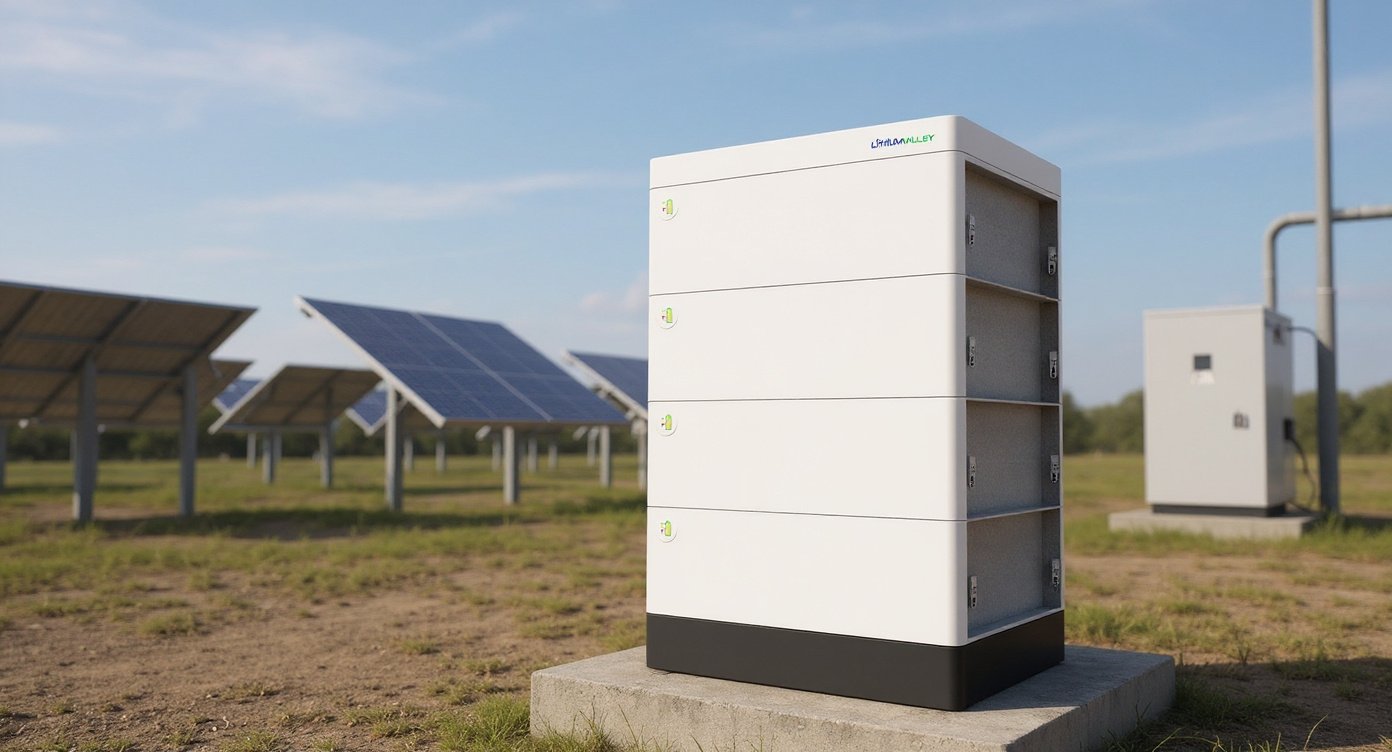
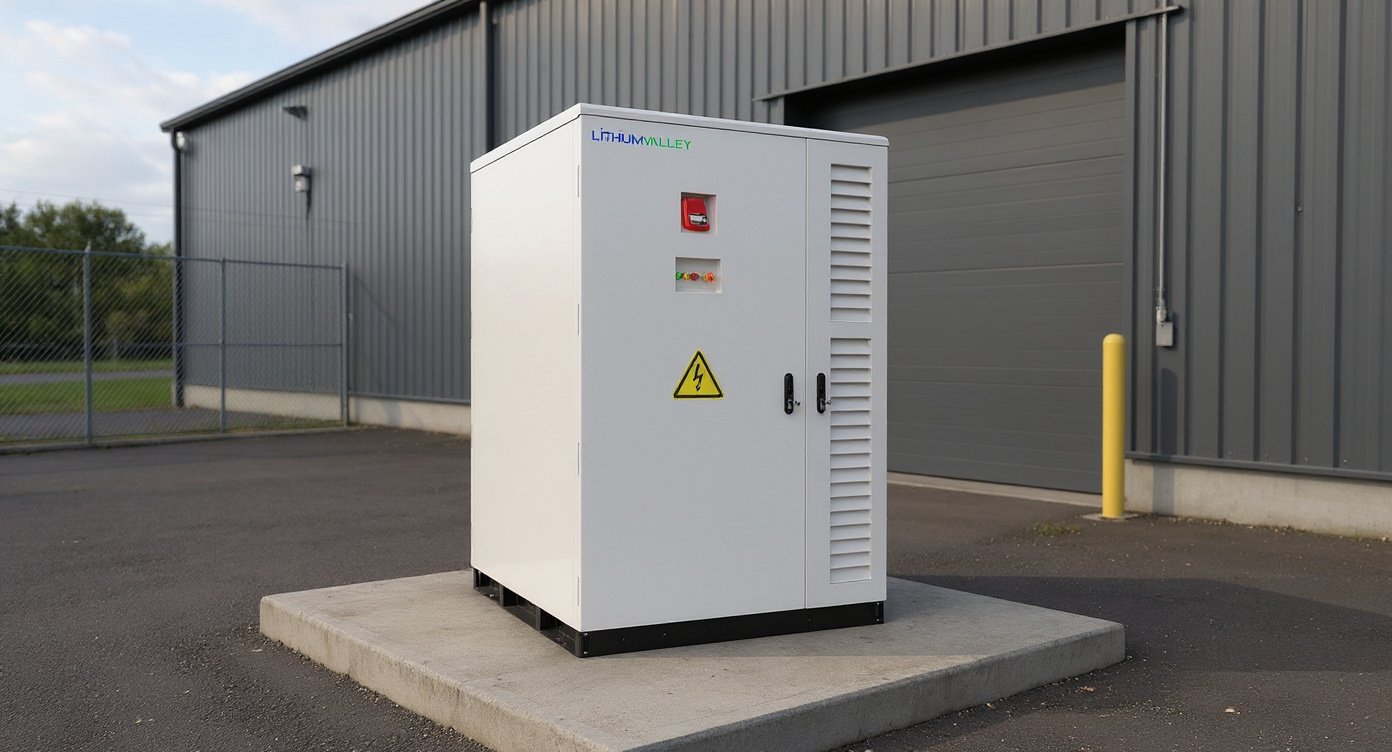
This guide covers the design work behind a large-scale commercial and industrial high-voltage LiFePO4 ESS: modular metal battery cabinets, technical battery-module assemblies, blue cells, silver or white enclosures, and the PCS, BMS, EMS, protection, communications, ventilation and site work around them.
Use these shortcuts if you need them: power versus energy, backup reserve, quote comparison, project example, and buyer FAQs.
How to size a scalable C&I battery energy storage system
Start with 12 months of utility interval data. Fifteen-minute data suits many demand-charge tariffs. Five-minute or one-minute meter data matters when a site has welders, crushers, large motor starts, compressors, injection molding equipment, or fast-changing data-center load.
Pull out four numbers first:
1. The highest measured kW demand and the time stamp for each peak.
2. How long each peak stayed above the target demand limit.
3. The kW of loads that must remain live in an outage.
4. The available grid capacity and time window for recharge.
Then calculate power and energy as separate requirements.
`Usable battery energy (kWh) = discharge power (kW) × discharge duration (hours)`
A 500 kW reduction for two hours needs 1,000 kWh of usable battery output before losses, reserve policy and aging allowance. It does not mean a 1,000 kWh nameplate battery will meet the task.
For a first-pass design, add three allowances:
| Design allowance | Example assumption | Why it belongs in the model |
|---|---|---|
| AC round-trip loss | 15% loss | NREL’s utility-scale lithium-ion benchmark uses 85% round-trip efficiency. C&I results vary with PCS loading, HVAC and auxiliary loads. |
| End-of-life capacity reserve | 15% to 25% | The project needs to meet its duty near the warranty endpoint, not only at commissioning. |
| Backup state-of-charge reserve | 20% to 50% | A peak-shaving system cannot spend the energy promised for outage support. |
| Recharge margin | Site-specific | The transformer, service entrance and tariff window must support recharge before the next event. |
| Temperature and auxiliary load margin | Site-specific | Forced-air cooling, room ventilation and cold-weather operation consume energy or limit output. |
The 85% figure is not a universal promise. It is an NREL planning assumption for a four-hour utility-scale lithium-ion system, useful as a starting point rather than a project guarantee. See the NREL Annual Technology Baseline battery storage assumptions.
Short peaks change the answer. A site trying to clip a 900 kW peak for 15 minutes needs 225 kWh at the battery output, plus losses and reserve. A site carrying 900 kW for three hours needs 2,700 kWh before those allowances. Same power. Twelve times the energy.

Power versus energy in a scalable C&I battery energy storage system
Power is the rate of work, measured in kW or MW. Energy is the amount stored, measured in kWh or MWh.
A 1 MW / 1 MWh system can provide 1 MW for about one hour under stated test conditions. A 1 MW / 4 MWh system can support that output for about four hours. Both can be called “1 MW BESS.” They are not comparable purchases.
| System duty | Primary sizing driver | Common trap | Better question |
|---|---|---|---|
| Demand-charge management | PCS kW and peak duration | Buying MWh without enough PCS power | How many kW must disappear from the billing peak? |
| Solar load shifting | Usable kWh and solar profile | Assuming noon surplus equals evening value | How many kWh are curtailed or exported at low value? |
| Outage support | Critical-load kW and runtime | Calling the whole facility “critical” | What remains energized after load shedding? |
| Microgrid operation | Protection, controls and generation mix | Treating a battery as a generator replacement | What source charges the battery after an extended outage? |
| EV charging support | Fast load ramps and service limit | Ignoring transformer headroom | Can the site recharge the battery after the charging rush? |
A scalable C&I battery energy storage system can serve more than one duty, but the EMS needs an operating hierarchy. Peak shaving can consume the same stored energy needed for backup. There is no clever software fix for a battery that has been discharged.
Not enough energy. Full stop.
Backup reserve is a business decision, not a battery feature
The phrase “backup power” gets used too loosely in commercial storage proposals.
A cold-storage warehouse may need refrigeration controls, selected compressors, emergency lighting, network gear and dock safety systems. It may not need every freezer motor, office circuit and battery charger. A manufacturing line may need a controlled stop sequence rather than four hours of full production.
On another bid review, the facility owner had listed every panelboard as critical. Once maintenance, production and safety staff marked what had to stay on, the outage load fell from 1,140 kW to 385 kW. That changed the battery design more than any cell specification did.
Set the reserve in writing. For example:
– Hold 40% state of charge for an outage.
– Permit demand-charge discharge from 100% down to 40%.
– Shed noncritical loads within 30 seconds of islanding.
– Preserve 260 kW for four hours after the load shed sequence.
This will not work if the site expects uninterrupted full-facility operation during a multi-day outage without a generator, solar resource, fuel plan, or grid restoration assumption. LiFePO4 cabinets are not magic. They store a finite number of kWh.
For safety and emergency planning, use the adopted local version of NFPA 855 alongside fire-code requirements and the authority having jurisdiction. System-level certification also matters. UL 9540 addresses energy storage systems and equipment; UL 9540A test data may be part of the fire-protection review for the proposed installation. The applicable code path depends on jurisdiction, occupancy, room layout and project scope.
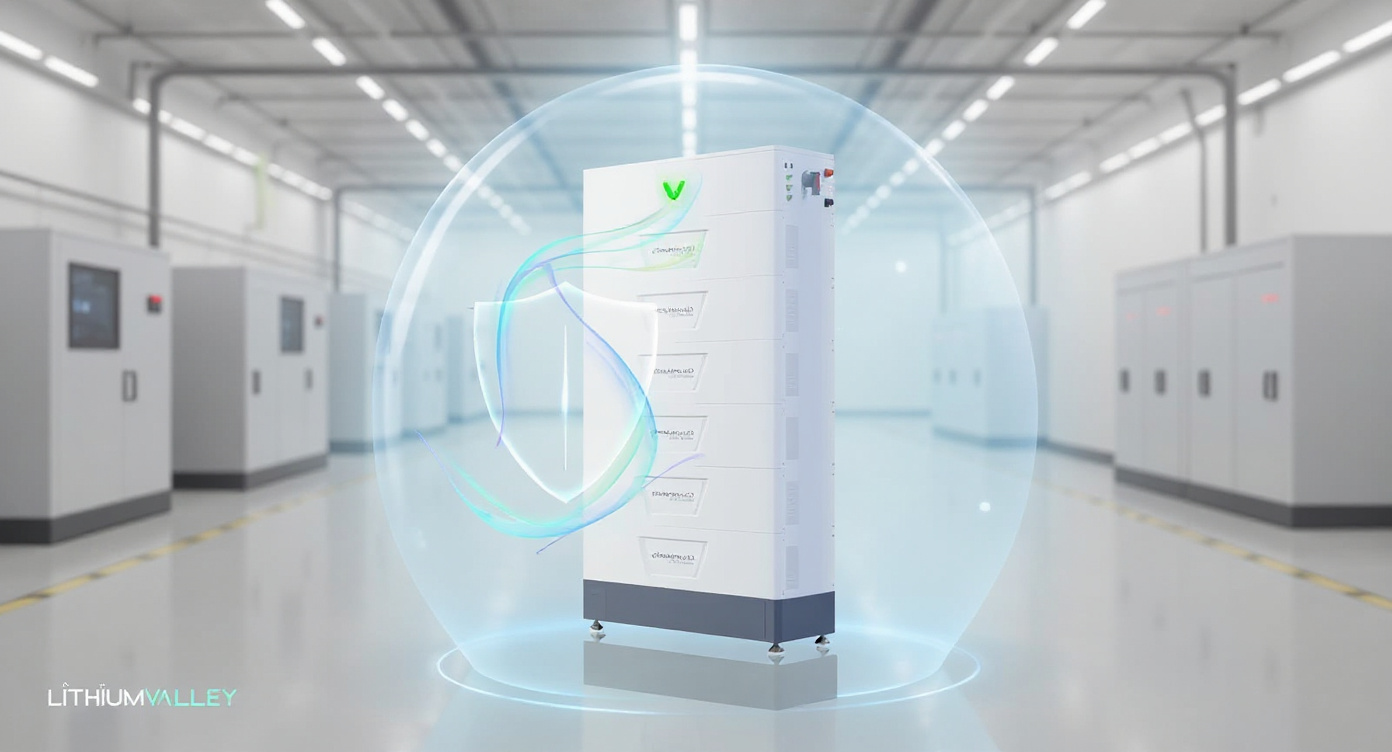
Product specification: LithiumValley FLEX16 cabinet platform
The LITHIUMVALLEY FLEX16 High Voltage C&I Energy Storage System is a modular high-voltage LiFePO4 ESS presented as commercial and industrial battery cabinets with metal enclosures and integrated battery-management architecture.
The public product page states 96 kWh nominal capacity per cabinet and identifies functions that include active cell balancing, BMS, EMS support, remote monitoring, CAN, RS485 and Ethernet communication, forced-air cooling, grid-tied operation, off-grid operation, peak shaving and emergency backup.
Here is the procurement-safe way to treat the published information:
| Item | Public product-page position | What the buyer must obtain before purchase |
|---|---|---|
| Cabinet energy | 96 kWh nominal per cabinet | Usable AC kWh at the proposed discharge rate, temperature and SOC window |
| Chemistry | LiFePO4 | Cell data sheet, pack architecture and warranty conditions |
| Cooling | Forced-air cooling | Room heat-rejection load, airflow path and maintenance plan |
| Communications | CAN, RS485 and Ethernet | Point list, protocol map, EMS and SCADA integration scope |
| Operating modes | Grid-tied, off-grid, peak shaving, emergency backup | Single-line diagram, transfer scheme and islanding sequence |
| Expansion | Modular cabinet format | Approved cabinet count, PCS limits, bus limits and warranty rules |
A prior public description paired 96 kWh per cabinet with a cabinet-count claim and a 3.08 MWh maximum project figure that did not reconcile by multiplication. Do not use that combination for design or financial modeling. The correct approach is to request a dated manufacturer submittal that states the approved cabinet count, DC architecture, nameplate kWh, usable kWh, PCS pairing and project maximum for the exact configuration.
That is not nitpicking. It is procurement.
For product-specific configuration discussion, see the FLEX16 high-voltage ESS page. For the broader sizing workflow in this article, return to the power and energy section, the reserve policy section, or the quote checklist.
Expansion planning: cabinets are not the whole system
A scalable C&I battery energy storage system is scalable only when the electrical architecture can grow with it.
Adding battery cabinets later may require more PCS capacity, a larger transformer, new switchgear sections, feeder upgrades, utility approval, protection-setting changes and more cooling capacity. Empty floor space does not create electrical headroom.
Ask these questions before ordering the first cabinet:
1. Is the PCS sized for the future power target or only the phase-one target?
2. Can the transformer accept the added charging load without a service upgrade?
3. Does the utility interconnection permit the planned export, non-export or charge behavior?
4. How will new cabinets be grouped with older cabinets that have different capacity and internal resistance?
5. Does the warranty allow later cabinet additions and mixed commissioning dates?
Honestly, some sites should skip staged expansion. If the facility has a known 2 MW load addition arriving next year and the interconnection work takes 14 months, buying a small first phase can create duplicate mobilization, duplicate engineering and a second outage window. Build the electrical backbone once if the growth is certain.
Project example: a demand-charge and backup design
This is an illustrative design calculation based on a food-processing facility load shape. It is not a performance promise.
The site’s tariff billed a $24/kW monthly demand charge. Its highest recurring peaks reached 1,120 kW during afternoon refrigeration and packaging overlap. The facility wanted to cap billed demand at 720 kW, a 400 kW reduction, for up to 90 minutes.
The demand-charge value was simple arithmetic:
`400 kW × $24/kW-month = $9,600 per month`
That is the gross demand-charge exposure before battery losses, missed dispatches, financing, maintenance, demand-ratchet rules and seasonal variation.
The same site required 250 kW of critical load for four hours during an outage.
– Peak-shaving energy: 400 kW × 1.5 hours = 600 kWh
– Backup energy: 250 kW × 4 hours = 1,000 kWh
– The backup duty governed because it required more stored energy.
– With 15% conversion loss and a 20% end-of-life allowance, the design team would model more than 1,470 kWh of battery-side nameplate energy before setting the final SOC reserve policy.
The EMS could use energy above the protected backup reserve for demand management. It could not promise full 400 kW peak shaving on every day and also guarantee four hours of backup after a late-day discharge. The owner had to choose the priority.
That is what a real operating plan looks like. A compromise.
Quote comparison for a scalable C&I battery energy storage system
Do not compare proposals by dollars per MWh alone. A low number can exclude site work, PCS equipment, fire detection, commissioning, SCADA integration, HVAC changes, warranty labor, shipping or utility studies.
Tesla Megapack, Fluence Gridstack, Wärtsilä GridSolv, Sungrow PowerStack, CATL EnerOne and many cabinet-scale LiFePO4 suppliers use quote-based project pricing. None offers a standard installed U.S. C&I price list that makes a direct apples-to-apples comparison possible. A public price of “$87,000 per cabinet” without duration, PCS rating, safety scope and installation cost tells you almost nothing.
Use one quote sheet for every vendor.
| Quote line item | Request | Reason |
|---|---|---|
| Power rating | Continuous AC kW, overload rating and duration | Determines whether peak clipping can occur at the target load |
| Energy rating | Nameplate DC kWh and usable AC kWh | Stops nameplate-only comparisons |
| Warranty | Years, throughput, retained capacity and exclusions | Reveals the promised end-of-life duty |
| Safety scope | UL listings, detection, suppression interfaces and room requirements | Prevents scope gaps between battery vendor and installer |
| Controls | EMS functions, dispatch rights, API access and alarm ownership | Determines who can operate the asset |
| Site work | Pads, conduits, switchgear, transformer, ventilation and commissioning | Often moves the installed project cost by six figures |
| Service | Remote support, on-site response, spare parts and labor rates | Defines downtime risk after handover |
For broad market context, the NREL storage cost and performance work is useful, but utility-scale benchmarks should not be pasted into an indoor C&I cabinet project. C&I projects carry different labor, building, interconnection and safety costs.
Buyer FAQs
What is a scalable C&I battery energy storage system?
It is a commercial and industrial energy-storage installation that combines high-voltage LiFePO4 battery cabinets, a PCS or inverter, BMS, EMS, communications, protection equipment and site infrastructure. “Scalable” means more battery capacity may be added if the PCS, transformer, switchgear, controls and interconnection allow it.
How many kWh do I need for 1 MW of battery power?
It depends on duration. A 1 MW battery supplying full power for 15 minutes needs 250 kWh of usable output. For two hours, it needs 2,000 kWh. Add losses, reserve energy and end-of-life capacity allowance before selecting nameplate capacity.
Can one C&I battery do peak shaving and backup power?
Yes. The EMS must preserve a stated backup reserve. If the battery discharges for demand management before an outage, the remaining state of charge sets the available backup runtime.
What does 96 kWh per cabinet mean?
It is nominal stored energy at the cabinet level. It is not the same as usable AC energy delivered to site loads. Ask for usable kWh at the proposed discharge rate, temperature range, SOC window and warranty endpoint.
Is LiFePO4 suitable for commercial and industrial ESS projects?
LiFePO4 is common in C&I storage because it offers long cycle capability and a thermal behavior many project teams prefer. Chemistry does not replace system design, certification, ventilation, protection coordination, fire planning or maintenance access.
How much does a 1 MW commercial battery system cost?
There is no credible single price. A 1 MW / 1 MWh system and a 1 MW / 4 MWh system have the same power rating but very different battery content, site work and operating value. Request an itemized proposal with equipment, PCS, electrical balance of plant, civil work, fire-safety scope, commissioning, controls and service separated.
What standards apply to a commercial battery room?
Requirements depend on the adopted code and the authority having jurisdiction. NFPA 855, UL 9540, local fire code, electrical code, building code and utility requirements are common references. The engineer of record and fire authority determine the accepted project path.
Can I add cabinets after the first phase?
Possibly. Confirm the approved expansion count, PCS headroom, DC bus limits, transformer capacity, utility permission, protection changes, warranty terms and rules for mixing new cabinets with older cabinets before phase one is built.
What information should I give a battery supplier before requesting a quote?
Provide 12 months of interval load data, tariff sheets, one-line diagrams, transformer data, service capacity, target kW reduction, outage-load list, desired runtime, solar or generator details, site drawings, room conditions and future-load plans. Better inputs produce a better scalable C&I battery energy storage system proposal.
The practical conclusion
A scalable C&I battery energy storage system earns its place when its kW rating, usable kWh, reserve policy, recharge window, controls and expansion path match the facility’s actual operating plan.
Start with load data. Mark the critical loads. Model the tariff. Then ask for a dated configuration submittal.
For projects considering modular high-voltage LiFePO4 battery cabinets with remote monitoring, active balancing, forced-air cooling and grid-tied through emergency-backup modes, the LITHIUMVALLEY FLEX16 High Voltage C&I Energy Storage System is a product platform worth reviewing. Confirm cabinet count, usable energy, PCS integration, room requirements and expansion limits against the final electrical design.