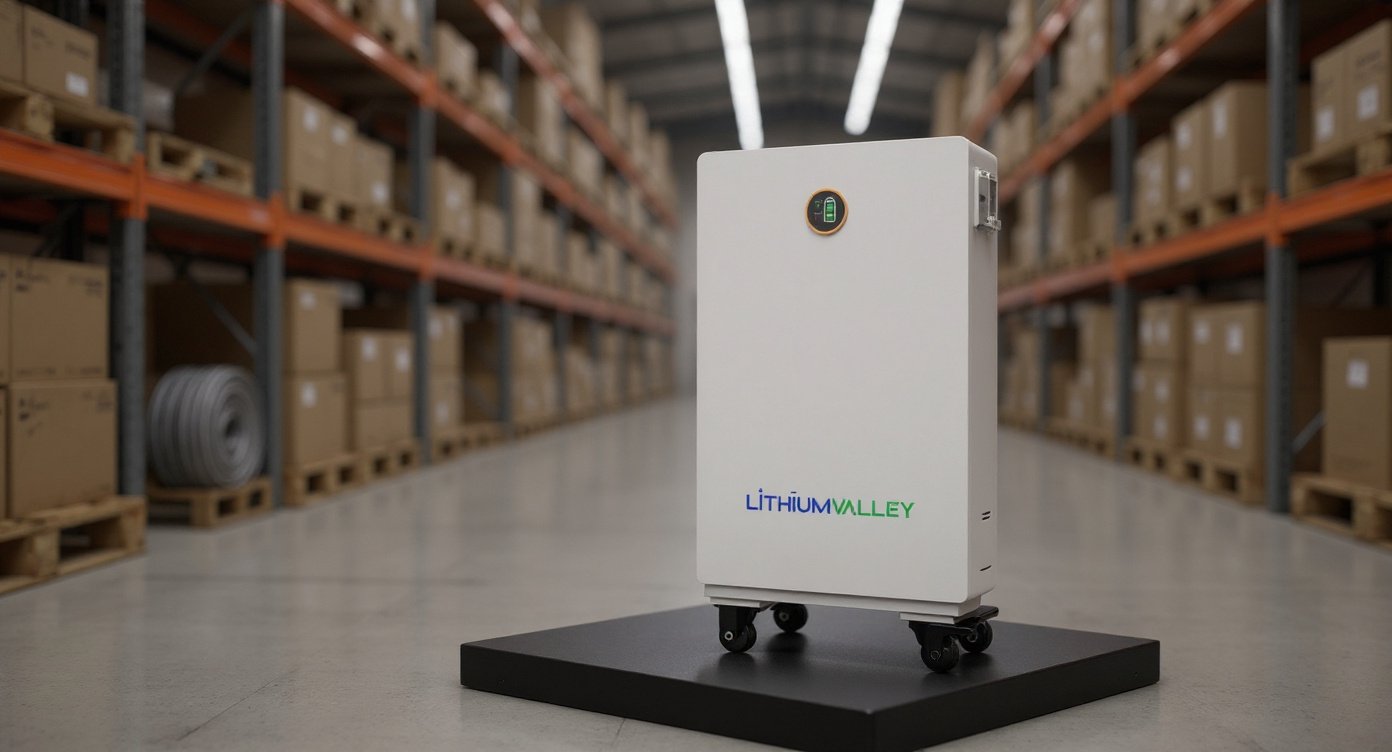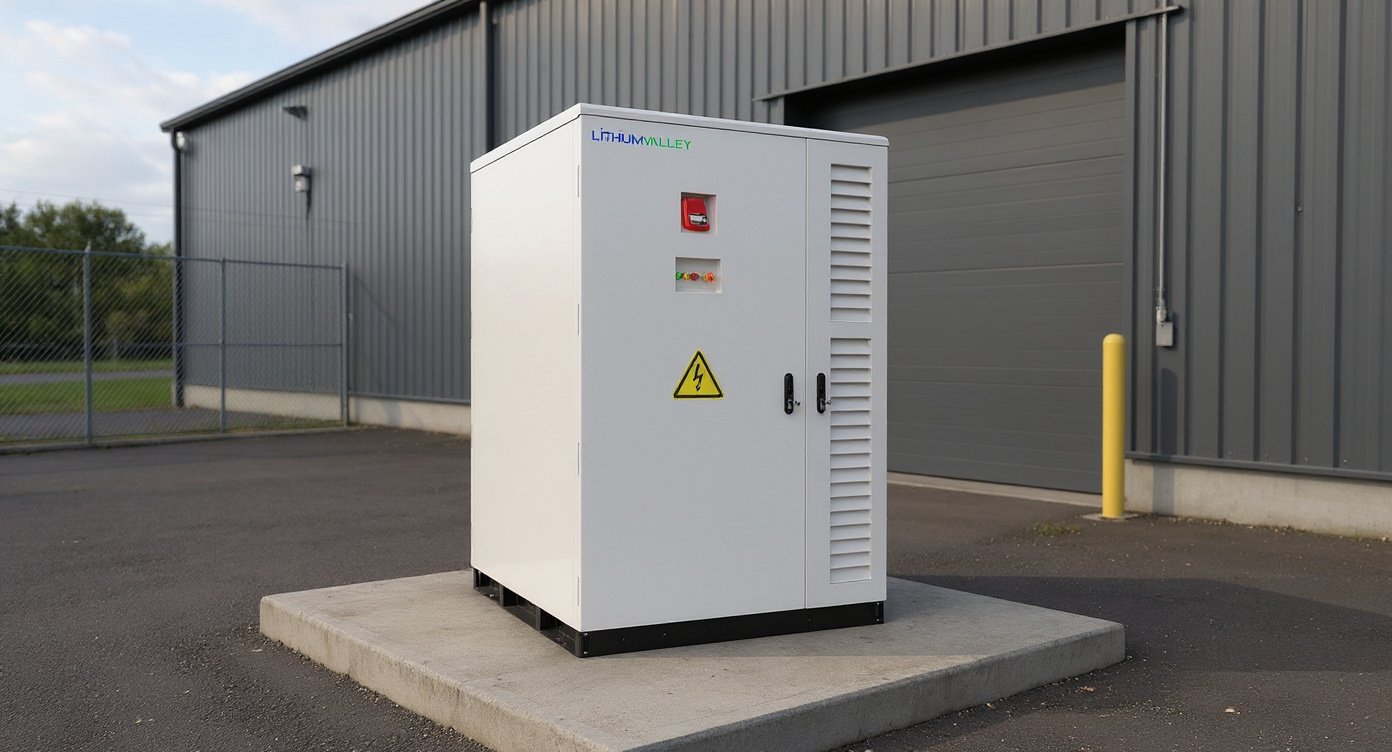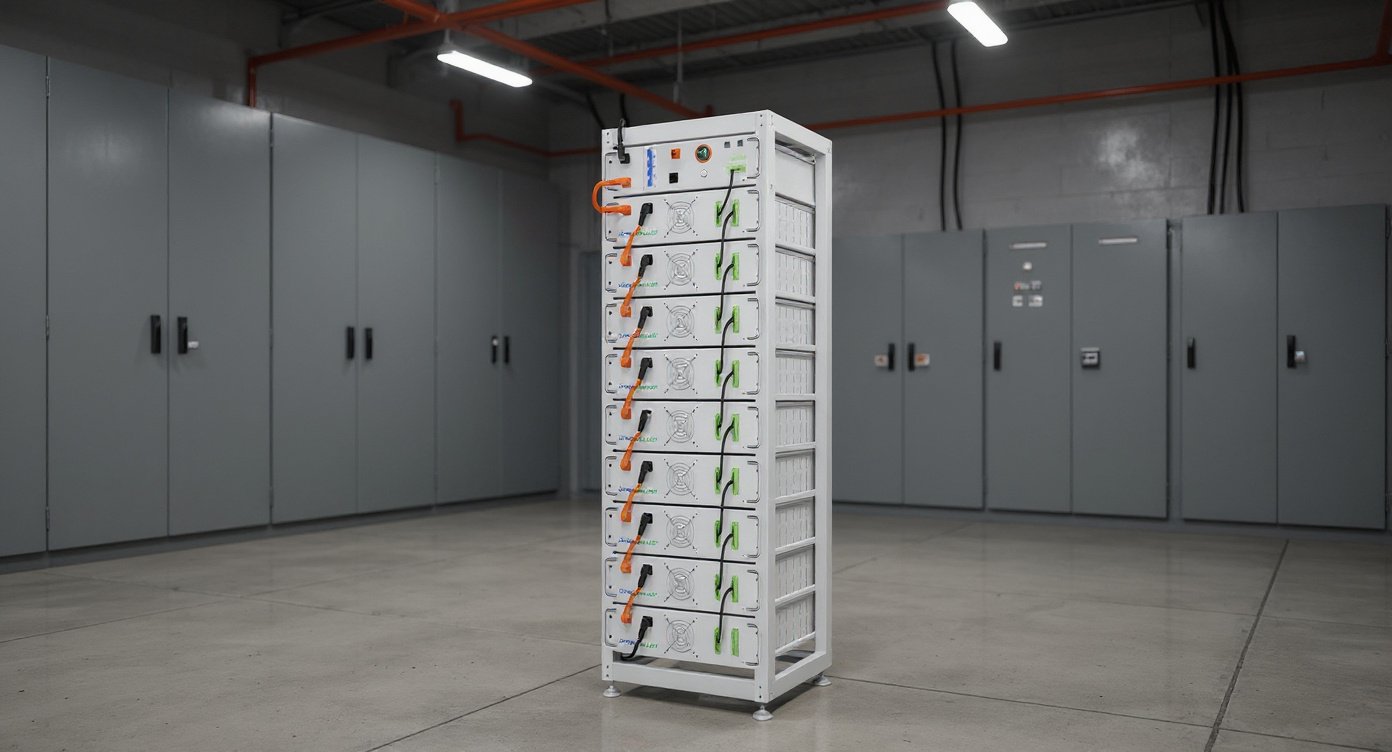
The LV-BST-L2.56Aa datasheet describes a 51.2V, 50Ah LiFePO4 stackable battery module with 2.56 kWh of nominal energy. It is a low-voltage residential storage product, built to stack vertically as a matched system rather than hang on a wall or slide into a 19-inch rack. Based on the manufacturer’s official product page, the defining facts are the 2.56 kWh module size, LiFePO4 chemistry, integrated BMS, and stackable enclosure. Confirm the current installation manual before ordering because inverter approval, maximum stack quantity, cable layout, dimensions, weight, and current limits can change with a hardware revision.
That last point matters.
The enclosure is not interchangeable with a rack battery, even when both products use 51.2V LiFePO4 cells. The LV-BST-L2.56Aa is a purpose-built stack system with a base, individual battery modules, front status controls, battery connectors, and a top control section. Don’t buy it as though it were just another 50Ah battery block.
I have seen this mistake in small backup projects. A customer once chose a cheaper rack battery because the nameplate voltage matched their inverter, then spent another $286 on a cabinet, busbars, cables, and labor to make the arrangement serviceable. The original stack format would have cost more per kWh, but less as an installed system.
LV-BST-L2.56Aa specifications at a glance
| Item | Confirmed or stated product information | What it means in a home system | Source to retain with your quote |
|---|---|---|---|
| Product model | LV-BST-L2.56Aa Stackable Battery | Exact stackable product family, not a rack-mounted substitute | Lithium Valley product page |
| Nominal voltage | 51.2V | Designed for a 48V-class low-voltage inverter battery port | Manufacturer product information |
| Nominal capacity | 50Ah | Electrical capacity of one battery module | Manufacturer product information |
| Nominal energy | 2.56 kWh | Energy before inverter losses and reserve settings | 51.2V x 50Ah calculation |
| Cell chemistry | LiFePO4 | Better thermal stability and cycle life than many NMC home batteries, with a larger physical footprint per kWh | Manufacturer product information |
| Battery management | Integrated BMS | Monitors cell voltage, temperature, and battery operating conditions | Manufacturer product information |
| Physical format | Vertical stackable modules | A floor-standing modular battery arrangement | Official source images and product page |
| Stack limit, weight, dimensions, current limits | Must be confirmed for the delivered revision | Governs runtime, inverter size, floor load, clearance, and expansion | Current LV-BST-L2.56Aa datasheet and installation manual |
The arithmetic is straightforward: 51.2V multiplied by 50Ah equals 2.56 kWh nominal energy per module.
Usable energy will be lower. Every battery has a protected operating window, and the inverter also consumes energy while converting DC power to AC. If an installer designs around 90% usable battery capacity and 94% inverter efficiency, one module yields about 2.17 kWh at the AC side. That is a planning figure, not a manufacturer warranty value.
A single module can cover a modest overnight essential-load panel. Think refrigerator, internet equipment, a few lights, and a gas-furnace blower. It will not make a 7 kW electric range disappear as a design problem. No battery does.

What the LV-BST-L2.56Aa is, and what it is not
The LV-BST-L2.56Aa Stackable Battery is best understood as a modular battery platform. Each 2.56 kWh module increases stored energy. The stacked architecture keeps cables short, preserves a tidy footprint, and gives an installer one clearly defined battery assembly to commission.
It is not a universal 48V battery.
Voltage match alone is not enough. An inverter needs the right charge and discharge limits, communications protocol, connector arrangement, firmware support, and startup sequence. A battery can power an inverter without communications in some cases, but that open-loop arrangement may void support or leave the inverter blind to temperature and current limits.
Honestly, if your installer cannot produce a written compatibility confirmation for the exact inverter model, skip this battery entirely. A lower sticker price is meaningless when the system starts throwing communication alarms on a cold Saturday morning.
Capacity planning: start with the loads, not the stack height
A 2.56 kWh module is a useful increment because it lets you build capacity in small steps. It also means a small system can become underpowered when buyers focus only on total kWh.
For example, a home with a 600W overnight essential load needs about 7.2 kWh for twelve hours. At an estimated 2.17 kWh of delivered AC energy per module, that load calls for four modules, not three. Three modules provide about 6.51 kWh under that planning assumption. Close is not enough during an outage.
Here is a more useful way to think about it:
| Example backup goal | Estimated AC energy needed | Planning module count | Important catch |
|---|---|---|---|
| Router, lighting, refrigerator for 8 hours | 3.6 kWh | 2 modules | Refrigerator compressor startup still affects inverter sizing |
| Essential loads overnight, 600W average for 12 hours | 7.2 kWh | 4 modules | Reserve settings reduce available runtime |
| Small off-grid cabin, 4 kWh daily use | 4.0 kWh | 2 modules | Solar charging must replace the energy each day |
| Time-of-use shifting, 10 kWh usable target | 10.0 kWh | 5 modules | Confirm stack and parallel-stack limits first |
| Whole-home backup with electric heat | Varies sharply | Often not suitable without load management | Heating loads can overwhelm the inverter before battery energy runs out |
The planning count in this table uses 2.17 kWh of estimated delivered energy per module. It is deliberately conservative. Your installer should use the usable-energy specification stated in the current LV-BST-L2.56Aa datasheet, plus the actual inverter efficiency and reserve setting.
Power is the second half of sizing. A battery stack may have enough energy for an evening but lack the allowed continuous discharge current for a large inverter. Ask for the continuous charge current, continuous discharge current, peak limit, and duration of the peak limit. Those numbers decide whether the system supports a kettle, well pump, heat pump, or air conditioner without a BMS shutdown.
Different problem.

BMS protection is valuable, but it should not be your operating plan
The LV-BST-L2.56Aa uses LiFePO4 cells and BMS monitoring with voltage and temperature protection. Those are necessary features. They are not a substitute for matching the battery to the inverter.
A well-configured inverter respects limits sent by the BMS. It reduces charge current when cells are cold, backs off near full charge, and stops discharge before the pack hits its low-voltage protection threshold. A poorly configured inverter drives the battery into protection, waits for recovery, then repeats the cycle. That is hard on equipment and annoying to live with.
The product documentation should state the following values for the exact revision shipped to you:
– Charge and discharge temperature range
– Cell and pack overvoltage protection thresholds
– Cell and pack undervoltage protection thresholds
– Charge and discharge overcurrent thresholds
– Short-circuit response and reset procedure
– Balancing start voltage and balancing current
– CAN, RS485, or other communications protocol
– Alarm behavior, shutdown behavior, and restart requirements
I learned to ask for the reset procedure after a garage installation where the battery stopped accepting charge at 3 degrees C. The battery was behaving correctly. The homeowner had been told only that it had “temperature protection,” which did not help at 6:40 a.m. when the inverter displayed an unfamiliar fault code.
Cold charging deserves special attention. LiFePO4 cells should not be charged below the manufacturer-approved temperature threshold unless the battery system includes and enables a suitable heating strategy. This won’t work if the stack sits in an unheated shed that drops below freezing every winter.
For broader residential energy-storage safety context, read UL’s residential energy storage safety-testing resource. Use the product manual, not a broad safety article, for LV-BST-L2.56Aa torque values, clearances, protection settings, and wiring instructions.
Inverter compatibility: insist on a model number
The right question is not “Does it work with a 48V inverter?” The right question is “Has the manufacturer approved this LV-BST-L2.56Aa revision with my exact inverter model and firmware?”
Ask for a compatibility letter, list, or email that identifies all four items:
1. Inverter manufacturer and exact model number.
2. Required inverter firmware version.
3. Battery communications port, cable, and protocol selection.
4. Approved maximum battery configuration for that inverter.
Brands such as Victron, Deye, Sol-Ark, Growatt, Luxpower, GoodWe, and SMA all sell inverter platforms that may support some low-voltage lithium batteries. That does not mean they support every 51.2V battery. Some require a specific CAN profile. Some allow voltage-controlled operation but not closed-loop BMS control. Some have regional firmware differences.
A price comparison can also mislead. An EG4 LL-S 48V 100Ah rack battery has commonly sold near $1,149 for 5.12 kWh in the U.S. market, while SOK’s 48V 100Ah server-rack battery has often listed near $1,599. Those batteries offer about twice the nominal energy of one LV-BST-L2.56Aa module, but they require a rack or cabinet and use a different physical format. Compare installed system cost, support, and compatibility. Not just dollars per kWh.
For system-level planning around electrical upgrades and household loads, the Department of Energy’s home energy upgrade guidance is worth reading before finalizing the inverter and backup-load panel.

Installation details that can stop a good project
The LV-BST-L2.56Aa stack belongs on a level, structurally suitable floor in a location permitted by the current manual and local electrical rules. The exact installed weight, module dimensions, base dimensions, anchoring method, and clearance requirements need to come from the current revision-controlled documentation.
Do not estimate floor loading from a product photograph.
The product’s stacked form has a practical advantage: it is easier to inspect than a homemade line of loose batteries. It also concentrates the system weight in a small footprint. In an older timber-framed house, that can matter more than people expect. A 10 kWh to 15 kWh battery system is not a side table.
Check these before the electrician arrives:
– Floor level, substrate condition, and concentrated-load suitability
– Required clearance above, behind, beside, and in front of the stack
– Cable bend radius and room to disconnect service connectors
– Water, flood, condensation, dust, direct sun, and heat-source exposure
– Access route from delivery point to final location
– Emergency isolation location and labeling
– Local permit, fire-code, and utility requirements
For a useful explanation of ESS labeling and residential installation review, see UL’s energy storage marking and residential-use guidance. It cannot replace local code review or the LV-BST-L2.56Aa installation instructions.
Documents to request before payment
Request these files in PDF form and make sure the model name matches the equipment quote:
– Current LV-BST-L2.56Aa datasheet, including electrical ratings and physical dimensions
– Current installation manual with stack sequence, torque specifications, and clearances
– Inverter compatibility list with firmware requirements
– Warranty document with cycle, throughput, temperature, and expansion terms
– Transport and storage instructions
– Declaration of applicable certifications for your sales region
Revision dates matter. Battery documentation is not decoration.
Frequently asked questions
What is the capacity of the LV-BST-L2.56Aa?
One LV-BST-L2.56Aa module is rated at 2.56 kWh nominal energy, based on a 51.2V nominal voltage and 50Ah nominal capacity. Usable energy is lower because the BMS protects part of the cell voltage range and the inverter has conversion losses.
Is the LV-BST-L2.56Aa a 48V battery?
Yes, it is a 51.2V nominal battery, which places it in the common 48V-class low-voltage inverter category. Do not treat that classification as proof of inverter compatibility.
Does the LV-BST-L2.56Aa use LiFePO4 cells?
Yes. The manufacturer identifies the LV-BST-L2.56Aa as a LiFePO4 battery system. LiFePO4 is a sensible chemistry for stationary storage because it has a stable thermal profile and long cycle potential, although it can be bulkier than higher-energy-density chemistries.
How many modules can be stacked?
The product is designed for vertical stacking, but the permitted maximum module count must be taken from the current installation manual for the exact product revision. Confirm both the maximum modules in one physical stack and any limit on parallel stacks.
How much usable AC energy should I expect from one module?
For initial load planning, about 2.17 kWh of delivered AC energy per module is a conservative estimate using a 90% usable battery window and 94% inverter efficiency. Use the manufacturer’s stated usable-energy value for final system design.
Can I add LV-BST-L2.56Aa modules later?
Possibly, but get the expansion rules in writing first. Many lithium systems require similar module state of charge, matching firmware, a limited age difference, or an approved commissioning process when new and older battery modules are combined.
Which inverters work with the LV-BST-L2.56Aa?
Use the manufacturer’s current compatibility list for the exact battery revision. The list should identify inverter models, firmware versions, communications protocol, cable requirements, and approved battery quantity. A matching 51.2V nominal voltage is only one part of the requirement.
Can this battery be installed in a garage?
A garage can be suitable if the product manual permits it and the location stays within the approved temperature, moisture, clearance, and impact-protection conditions. Avoid locations that freeze, flood, collect condensation, or place the battery in the path of a vehicle.
What should be on an installer commissioning record?
The record should include battery serial numbers, firmware versions, inverter model and firmware, battery communications status, installed module count, charge and discharge settings, protective-device details, and the tested shutdown and restart sequence.
Bottom line
The LV-BST-L2.56Aa is a 2.56 kWh, 51.2V, 50Ah LiFePO4 stackable battery module with integrated BMS monitoring. Its strongest case is a tidy modular residential system where you need capacity growth in 2.56 kWh steps and have confirmed closed-loop inverter support.
Before you buy, get the current LV-BST-L2.56Aa datasheet, installation manual, warranty, and inverter compatibility confirmation for the exact hardware revision. That is the difference between a battery stack that looks neat on delivery day and one that remains easy to service five years later.