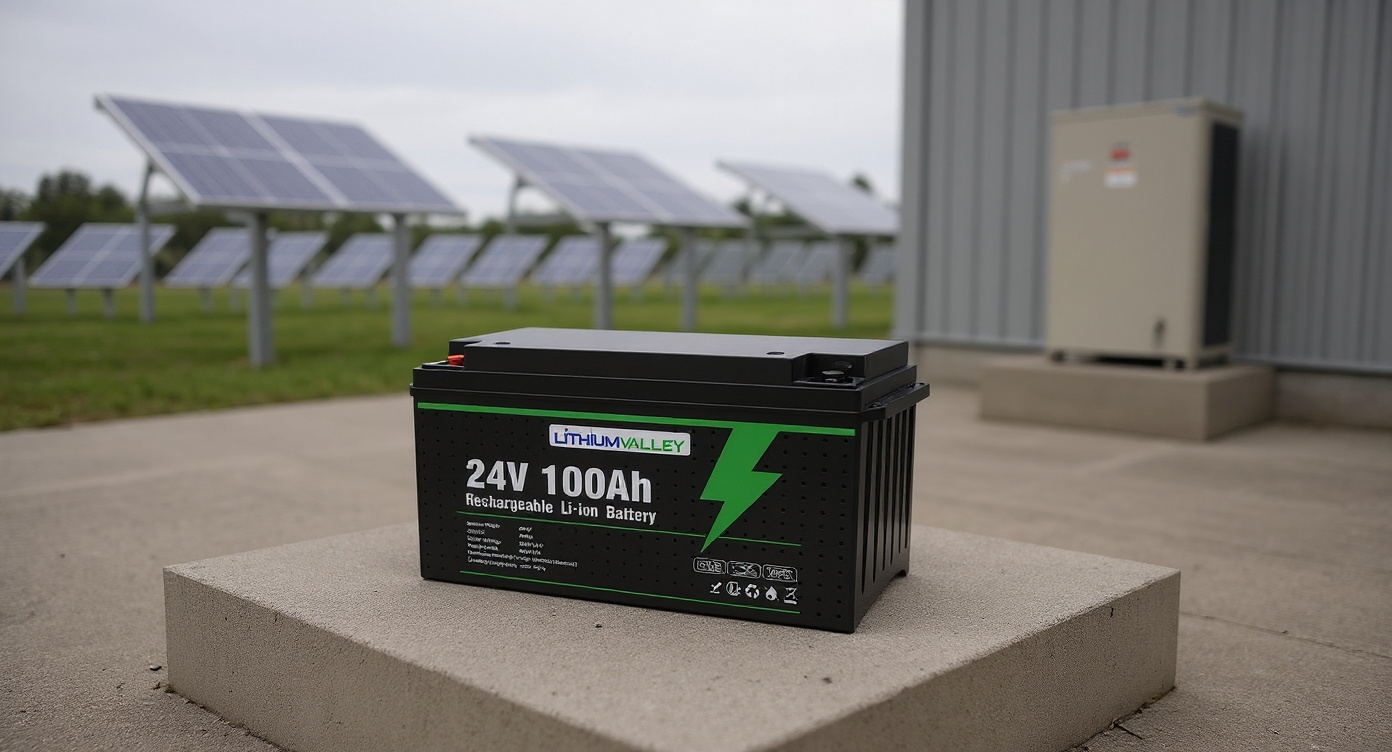
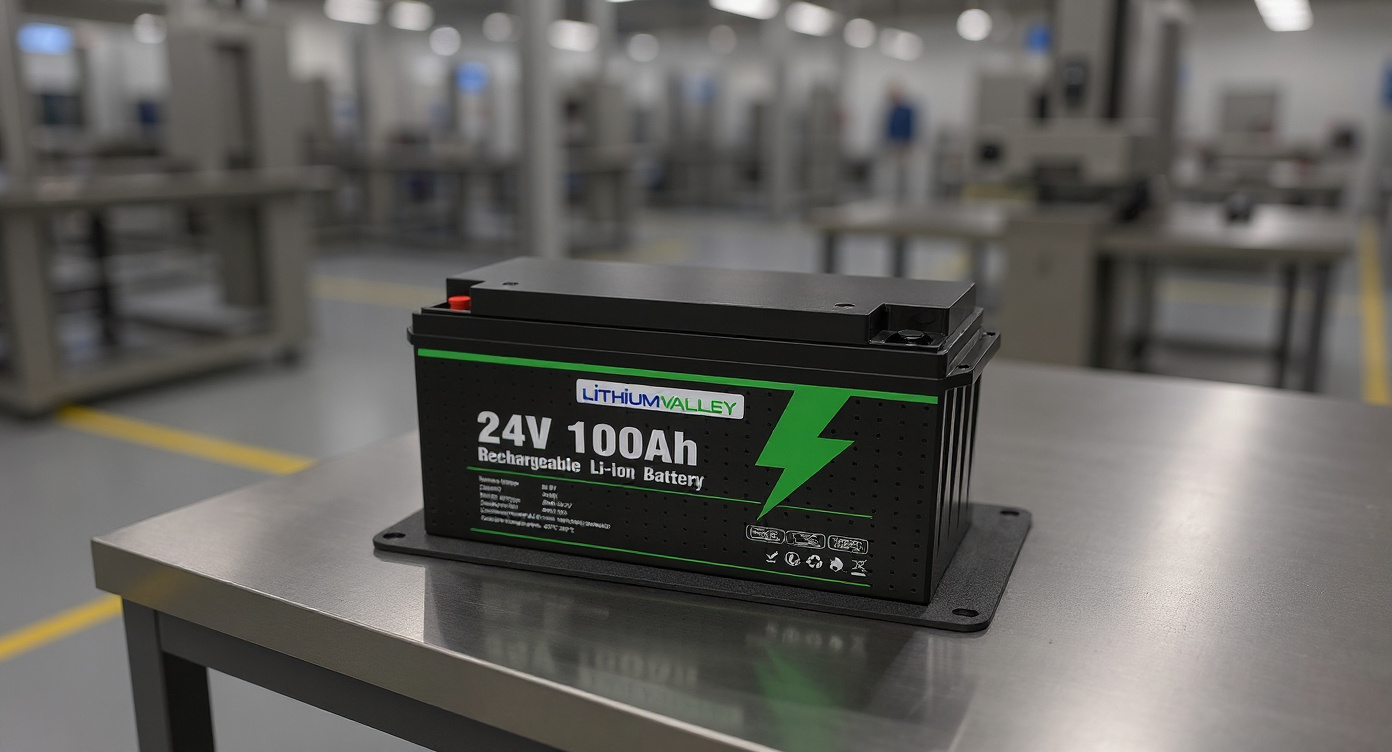
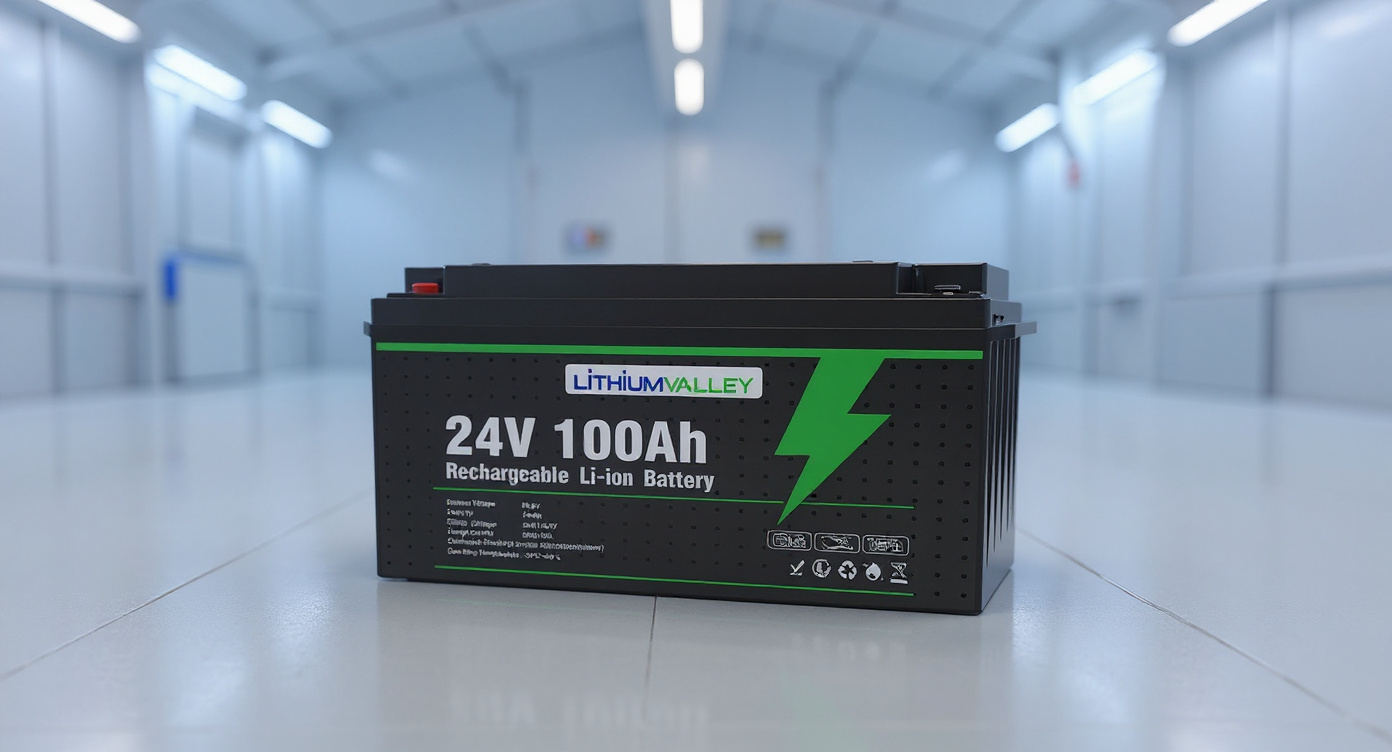
25.6V 100Ah usually means a lot more than the label suggests: it’s a 24V-class lithium battery with enough stored energy for serious lead-acid replacement work, and it’s often the right fit when you want steadier voltage under load. If you’re trying to decode 25.6V 100Ah capacity and voltage, the short version is simple, it gives you a nominal 25.6 volts and 100 amp-hours, which works out to about 2.56 kWh before losses.
That matters because people don’t buy batteries for the label, they buy them for runtime, charge behavior, and how well they fit the rest of the system. This one is designed as a lead-acid replacement battery, with an integrated BMS, protection recovery, and parallel module operation, so the real question isn’t just “what does 25.6V 100Ah mean,” it’s whether your charger, inverter, and wiring actually match it.
What 25.6V and 100Ah actually tell you
Voltage is the system’s pressure. Amp-hours are the tank size. Put them together and you get a usable picture of what the battery can do, but only if you stop treating the numbers like magic.
25.6 volts is the nominal voltage, not the fully charged voltage and not the cutoff voltage. In everyday use, that puts it in the 24V replacement bucket. The 100Ah part means the battery can supply 100 amps for one hour, or 10 amps for 10 hours, in a simplified math sense. Real use depends on inverter losses, wiring, temperature, and how deeply you discharge it.
A quick conversion helps. Power in watts is volts times amps. So a 25.6V battery delivering 40A is supplying about 1,024W. At 100A, you’re at 2,560W. That’s the clean math, not the guaranteed real-world answer.
Here’s the part people miss: lithium holds voltage more steadily than lead-acid, so your equipment often sees a less dramatic drop during discharge. That’s why a battery like this 25.6V 100AH unit can feel larger in practice than a lead-acid bank with the same nominal rating.
Why it replaces lead-acid better than a straight label match
A lead-acid bank and a lithium pack can share a voltage class and still behave very differently. Lead-acid voltage sags hard as it drains. Lithium iron phosphate stays flatter for longer, which means the inverter and loads usually get more consistent input until the battery management system steps in.
That doesn’t make lithium automatically better for every setup. It does make it more attractive when you want usable capacity, lower maintenance, and fewer partial-charge headaches. The product page notes an integrated BMS and protection recovery, which are the kinds of features that matter in replacement installs because they help the battery protect itself and recover after a fault event.
The phrase 25.6V 100Ah capacity and voltage gets thrown around like it’s a full spec sheet. It isn’t. For a replacement job, I’d still confirm charger profile, current limit, terminal layout, enclosure dimensions, and maximum parallel count before anything goes in a cabinet or trailer.
A lead-acid swap usually pays off when the load is moderate to high, the battery gets cycled often, and you care about voltage stability more than the lowest upfront price. If your system sits idle most of the year, the case gets weaker.
What you can run, and for how long, without guessing
Use the watt-hour math first, then trim for real use. A 25.6V 100Ah battery stores about 2,560Wh nominally. If you only want to use 80% of that for a conservative estimate, you’re at roughly 2,048Wh available before conversion losses.
That gives you a rough runtime picture:
1. A 100W load can run for about 20 hours before losses.
2. A 300W load can run for about 6 to 7 hours.
3. A 1,000W load can run for about 2 hours, give or take inverter efficiency.
4. A 2,000W load pushes the battery much harder and shortens runtime quickly.
5. Short bursts above that may be possible if the BMS and wiring allow it, but that’s a system question, not a label question.
Use-case fit depends on the actual draw pattern. A fridge, router, lighting, and a few tools are a very different story from a big resistive heater or a heavy motor start. Battery labels don’t tell you surge behavior by themselves.
| Load example | Approx. draw | Rough runtime from 2,560Wh nominal |
|---|---|---|
| Small electronics | 50W | 40+ hours |
| Light household mix | 200W | about 10 to 12 hours |
| Modest inverter load | 500W | about 4 to 5 hours |
| Heavy continuous load | 1,000W | about 2 hours |
| Very heavy load | 2,000W | under 1.5 hours |
Those are planning numbers, not guarantees. Inverter efficiency, battery cutoff, and temperature all move the target.
Compatibility checks that save you from a bad swap
The battery can be a good match and still be wrong for the system. That’s why I’d verify these items before replacing lead-acid with lithium.
1. Charger profile. It needs to suit LiFePO4 charging behavior, not a random flooded-lead setting.
2. Terminal orientation. One flipped layout can turn a simple install into a wiring mess.
3. Enclosure dimensions. Don’t assume it fits because the voltage class matches.
4. Maximum charge and discharge current. The page says to confirm current limits, and that’s not busywork.
5. Parallel limit. The product context mentions parallel module operation, but the maximum count still needs checking.
6. Inverter input range. Some inverters are picky about voltage windows and low-voltage cutoff.
7. Cable size and fuse protection. A 100Ah battery can still dump serious current.
If you’re replacing an older 24V lead-acid bank, the main trap is assuming the old charger is automatically fine. Sometimes it is. Sometimes it isn’t. I wouldn’t trust guesswork here.
The 25.6V 100AH unit is the kind of battery that can simplify a system when the rest of the hardware is already close to spec. It’s not the battery that usually causes trouble. It’s the mismatch around it.
Parallel banks, charging, and the maintenance habits people skip
Parallel operation is useful when one battery isn’t enough capacity, or when you want to spread the load across multiple units. But parallel only works cleanly when the batteries are matched well and the system is built for it.
For charging, LiFePO4 usually wants a compatible profile and controlled voltage behavior. A 24V charger may work if it’s actually set up for the battery’s lithium profile, but a generic lead-acid charger is not something I’d blindly reuse. The battery’s BMS can help with protection, but it doesn’t turn the wrong charger into the right one.
Maintenance is lighter than lead-acid, not nonexistent. The EPA has a useful plain-English guide on how used lithium-ion batteries should be handled and recycled, and that matters because end-of-life planning is part of buying any battery, not an afterthought.
For a battery like this, the practical maintenance list is short:
– Keep connections tight and clean.
– Use the right charger profile.
– Check that the enclosure still has physical clearance for airflow and service access.
– Watch for imbalance if you build a parallel bank.
– Store it in the operating window the maker recommends, not just wherever there’s space.
The less drama you want later, the more boring the install should be now.
25.6V 100Ah capacity and voltage in plain English for real buyers
This is the part where the label finally gets useful. 25.6V tells you the battery sits in the 24V-class lane. 100Ah tells you the size of the tank. Together, they tell you the battery is aimed at systems that need more than a small backup pack but don’t need a huge rack setup.
A product with integrated BMS protection and parallel module operation is most attractive when the replacement job has a real load pattern, a stable mounting spot, and a charger you can verify. If one of those pieces is shaky, the battery may still be the right chemistry, just not the right fit yet.
It’s also why I wouldn’t talk about this as a universal upgrade. If your current bank is lightly used and already paid for, the math is different. If your lead-acid setup wastes usable capacity and keeps dragging voltage down under load, the case for lithium gets much stronger.
FAQ
1. Can I use a 24V charger on a 25.6V LiFePO4 battery?
Sometimes, but only if the charger’s profile is compatible with LiFePO4. A generic lead-acid charger is not the same thing.
2. How many watts can 25.6V 100Ah support?
On paper, 25.6V times 100A is 2,560W. Real usable wattage depends on the BMS, inverter, wiring, and discharge limits.
3. Can I connect 25.6V 100Ah batteries in parallel?
Yes, if the product and system support parallel module operation and the batteries are matched and installed correctly. Confirm the maximum parallel count first.
4. Is 25.6V the same as 24V?
It’s the 24V-class nominal replacement voltage, yes. It’s not the exact same number, but it’s commonly treated that way in system matching.
5. How long will a 25.6V 100Ah battery last?
Nominal energy is about 2,560Wh. Runtime depends on the load, inverter efficiency, and how deeply you discharge it.
6. Do I need a special inverter for LiFePO4?
Not always a special one, but you do need one with a voltage window and low-voltage cutoff that suit the battery. A lead-acid-friendly inverter may still work if the settings are right.
7. What terminal orientation and enclosure size should I confirm?
Check both before ordering or swapping. A wrong terminal layout or a cabinet that’s even a little too tight can turn a simple replacement into a bad fit.
So is it worth paying for the right fit?
If your pain point is weak lead-acid runtime, voltage sag, or constant maintenance, this type of battery is more likely to make sense when the charger profile, current limits, and dimensions all line up. If those pieces don’t match, the chemistry won’t save the install.
When you’re ready to check the actual hardware and confirm the fit for your setup, see 25.6V 100AH.